 727-243-078124/7 EMERGENCY SERVICE
727-243-078124/7 EMERGENCY SERVICE
727-243-078124/7 EMERGENCY SERVICE
We serve customers in Clearwater and the surrounding Pinellas County area from our Clearwater location at 2625 State Road 590, Clearwater, FL 33759, backed by our New Port Richey base. Service availability depends on location and scheduling. We provide practical plumbing diagnosis and repair for urgent and everyday plumbing problems.
Tell us what plumbing help you need.
Plumbing, drain and sewer service for Clearwater homes and businesses, from our 2625 State Road 590 location.
Plumbing problems can happen without warning. For urgent leaks, backups, damaged pipes and other plumbing issues, call us directly for the fastest response.
We also handle planned plumbing work, including drain and sewer service, water heater work and repiping.
Clearwater more than doubled in population during the 1950s, added another 50 percent in the 1960s and 64 percent in the 1970s. Most of the housing here was built between 1950 and 1985, and the drain material changed across those decades.
Homes finished before the mid-1970s usually have cast iron drain and waste lines. The Tampa Bay Estuary Program notes that houses built before 1975 are more likely to have sewer lines made of materials prone to leaks and cracks, specifically cast iron and Orangeburg. Cast iron rarely fails suddenly. It scales inward, catches paper and grease, and backs up repeatedly long before it breaks. A camera inspection tells you which of the two you have and whether the problem is one bad section or the whole run.
Clearwater disinfects with chloramines year round and switches to free chlorine twice a year as scheduled maintenance. Polybutylene supply pipe, usually grey and stamped PB2110, went into homes built roughly between 1978 and 1997, and it is the chlorine and chloramine compounds in treated water that break the pipe down from the inside.
Those two windows overlap Clearwater's late-1970s and 1980s building peak almost exactly. If your house is from that period and has grey plastic supply lines, trouble usually starts as a weep at a fitting or a bend rather than a burst.
Most homes inside the city limits are on City of Clearwater Public Utilities for both water and sewer. Some Clearwater-addressed homes sit in unincorporated Pinellas County and are served by Pinellas County Utilities instead, which your bill will confirm.
Pinellas County publishes area hardness at 10 to 15 grains per gallon, which is hard to very hard. In practice that means scale settling in the bottom of the water heater, shortened element life, restricted aerators, and mixing cartridges that stop sealing and start dripping.
Clearwater's utility has been straightforward about what heavy rain does to the collection system. After a storm in August 2024 dropped more than three inches quickly, the Marshall Street facility discharged roughly 11.1 million gallons of partially treated wastewater into Stevenson Creek.
That is a system-level problem, but the same rainfall gets in through cracked private laterals on individual properties. If your drains back up only during or just after heavy rain, say so when you call. It points toward groundwater entering the line rather than a blockage, and it changes what we bring.
On the barrier islands the ground is part of the problem. Island Estates was dredged from mangrove islands starting in 1957, and the city replaced more than 6,000 feet of cast and ductile iron water main there, attributing the deterioration to the corrosive nature of the salt water and sand.
Condominium buildings add shared stacks and shared responsibility. The first thing worth establishing is whether the symptom stops at your unit or involves the building's line, because that decides who is paying.
Clearwater requires a permit to install, alter, repair, remove, convert or replace any plumbing system, with an exemption only for work under $500 in job value. Water heater replacement and repiping are both well past that. Permits are issued by the city's Planning and Development Department.
For active water or sewage, call and give the exact address, access details and any shutoff steps already taken. Arrival timing depends on current calls and traffic, and we discuss a realistic window when the visit is scheduled.
Yes. Our Clearwater location is at 2625 State Road 590, Clearwater, FL 33759, backed by our New Port Richey base.
Quite possibly. Polybutylene is usually grey, half-inch to one-inch, and stamped PB2110, and it was installed in homes built from roughly 1978 to 1997. It was used for water supply only, never for drains. We can confirm it by looking at an exposed run at the water heater or under a sink.
That pattern usually points to groundwater or stormwater getting into the line through cracks in the private sewer lateral, rather than to a blockage. A camera inspection during or shortly after wet weather is the most useful way to see it.
Clearwater requires a permit to install, alter, repair or replace any plumbing system, with an exemption only for work valued under $500. A water heater replacement is well past that threshold. Permits are issued by the city's Planning and Development Department.
Hardness in this area runs 10 to 15 grains per gallon. That mineral load settles as scale in the bottom of a tank heater, insulates the element or burner, and makes the heater work harder. Periodic flushing helps; it does not eliminate it.
Arrival timing depends on current calls, traffic and the service address. Call to discuss current availability and a likely service window.
Real project photography from Emergency Plumbing & Drain Services. Photos are representative of our plumbing work and are not presented as work performed in Clearwater.
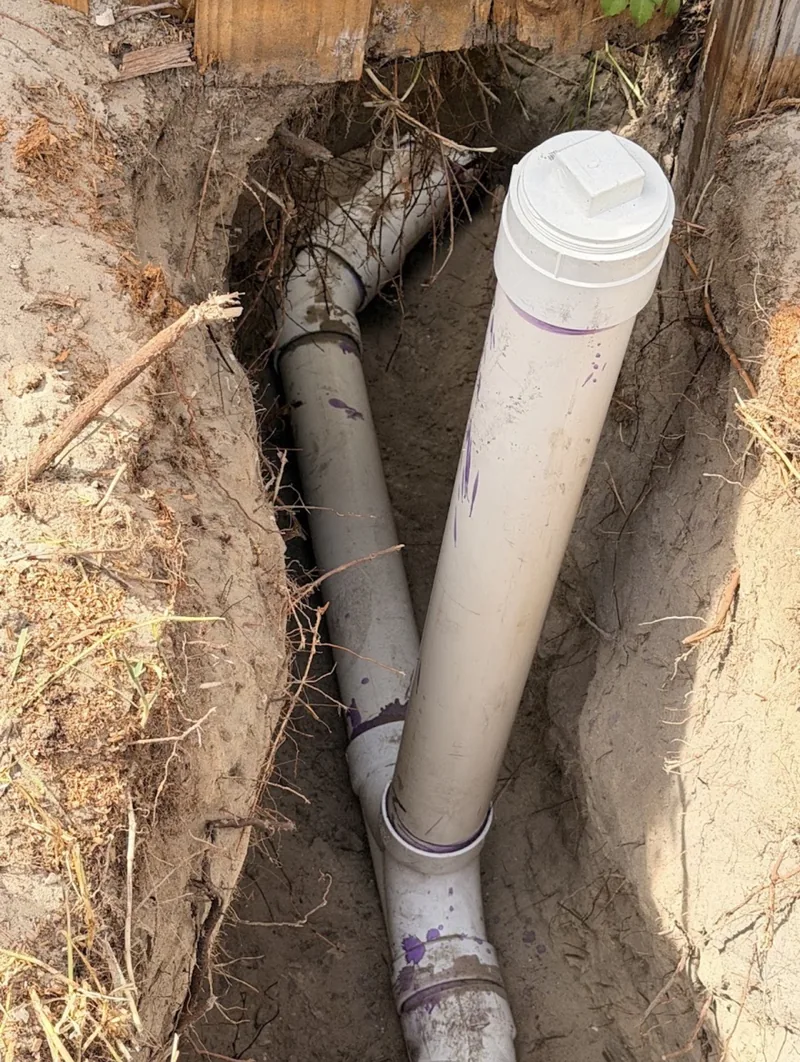
Emergency Plumbing & Drain Services serves Clearwater and the Tampa Bay area from 2625 State Road 590, Clearwater, FL 33759, with our main base in New Port Richey.
Florida Plumbing License #CFC1430395
CALL 727-243-0781For the fastest response, call us directly.
CALL 727-243-0781Clearwater: 2625 State Road 590, Clearwater, FL 33759
Main: 4210 Marine Parkway, New Port Richey, FL 34652